Generative Engine Optimization (GEO): The Complete 2026 Guide
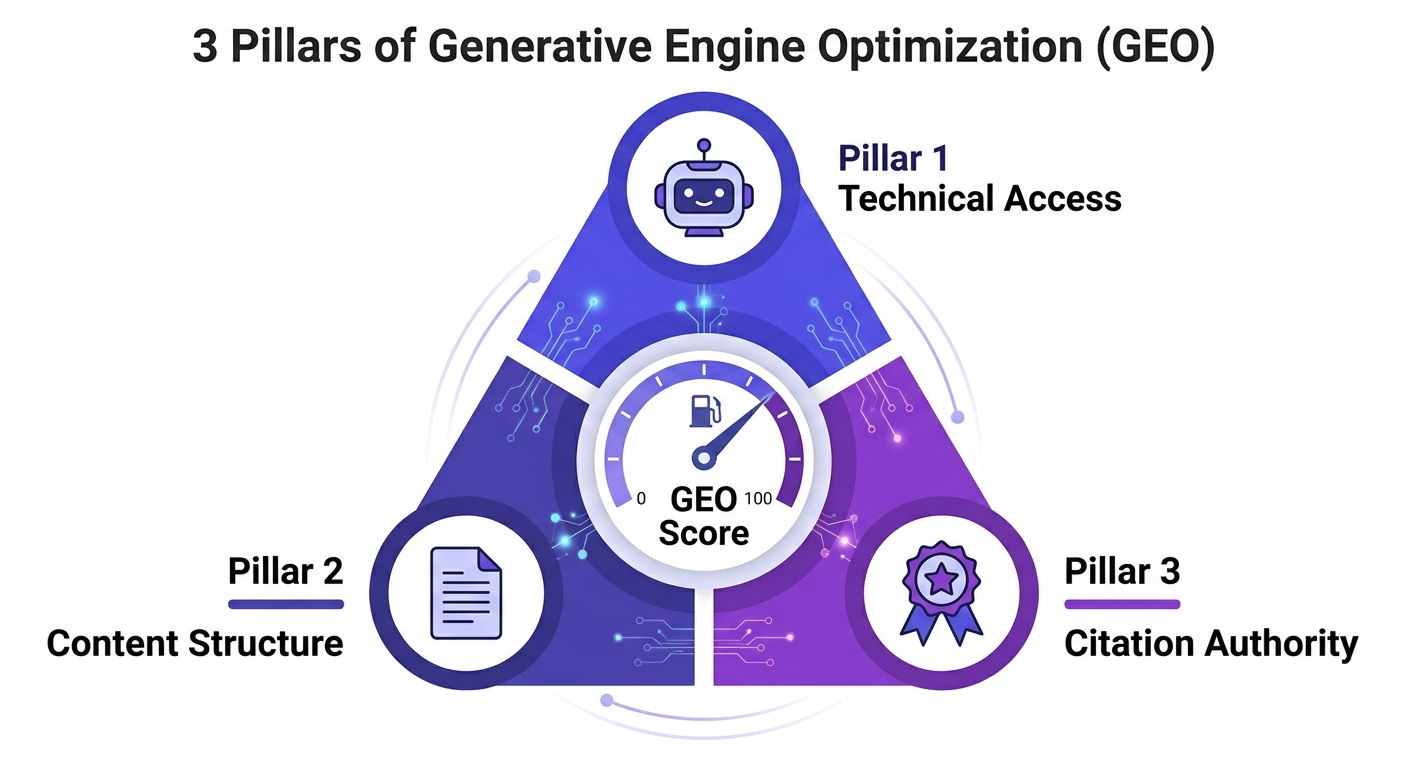
GEO (Generative Engine Optimization) is the practice of optimizing your brand to appear in AI-generated answers from ChatGPT, Gemini, Perplexity, Claude and Grok. Unlike SEO which targets Google rankings, GEO targets AI citations. Brands actively optimizing for GEO see 2-3x higher citation rates than those using traditional SEO alone.
What is Generative Engine Optimization?
Generative engine optimization (GEO) is the discipline of making your brand discoverable and citable inside AI-generated answers. When someone asks ChatGPT "best project management tool for remote teams," ChatGPT synthesizes an answer from its training data and, if live search is enabled, from current web sources. GEO determines whether your brand is in that answer or not.
The goal is not a ranking position. It is being included in a synthesized answer. There are no positions in GEO - there is cited and not cited.
| Approach | Target | Result |
|---|---|---|
| SEO | Google rankings | Position in a list of links |
| GEO | AI citations | Brand mentioned inside an AI answer |
| AEO | Voice answers | Direct spoken response |
Why GEO matters in 2026
The numbers are hard to ignore. AI search is not a trend that is coming - it is already mainstream, and it is pulling users away from traditional search at a measurable rate.
- ChatGPT: 900 million weekly active users as of 2026
- Perplexity: 630 million monthly searches
- Google AI Overviews: appear on over 40% of all Google searches
- Google-to-AI source overlap: dropped from 70% to under 20% in 18 months, meaning most AI citations come from pages that are NOT in Google's top 10
- Brands optimizing for GEO see 2-3x higher citation rates than those using traditional SEO alone
- Citation frequency accounts for 35% of AI answer inclusions according to GEO research from Princeton and Georgia Tech (2024)
- Gartner predicts a 25% reduction in traditional search volume by end of 2026
The implication for founders and marketers is clear: if you are only doing SEO, you are invisible to a growing share of your potential audience.
GEO vs SEO vs AEO
| SEO | GEO | AEO | |
|---|---|---|---|
| Target | Google rankings | AI citations | Voice answers |
| Goal | Rank position | Brand mention | Direct answer |
| Primary signal | Backlinks | Citation frequency | Schema markup |
| Key metric | Organic traffic | Mention rate | Snippet wins |
| Time to results | 3-6 months | 4-8 weeks | 2-4 months |
| Primary channel | ChatGPT, Perplexity, Gemini | Siri, Alexa |
How AI systems decide what to cite
Different AI systems use different mechanisms to decide what brands and pages to cite. Understanding this is key to building an effective GEO strategy.
Layer 1: Training data coverage (ChatGPT, Gemini, Claude)
ChatGPT and Claude are trained on large snapshots of the internet. If your brand was not well-represented in those datasets, you start from a low baseline. This is why established brands with years of press coverage and blog posts score higher by default. The fix is long-term: get more of your brand mentioned in indexed publications, directory listings, and content that gets into training datasets.
Layer 2: Live web presence (Perplexity, Google AI Overview)
Perplexity and Google AI Overviews retrieve content from the current web. This makes them far more responsive to recent optimization work. A page published this week can show up in Perplexity answers within days. The optimization requirements here are closer to traditional SEO: crawlability, structured content, authority signals.
Layer 3: Entity recognition
All AI systems have some form of entity recognition - the ability to identify your brand as a specific, real-world entity distinct from similar keywords. Entity recognition is built through consistency: the same brand name, description, founding year, product category, and key facts across your website, Crunchbase, LinkedIn, G2, Wikipedia (if eligible), and press coverage. Inconsistent descriptions confuse entity resolution.
Query fan-out
When someone asks "best GEO tool for startups," an AI system does not just run one search. It expands the query into multiple sub-queries:
- GEO tools 2026
- AI visibility software
- generative engine optimization platforms
- how to track AI citations
Your content needs to answer all of these sub-queries to maximize citation probability. Single pages targeting one keyword underperform compared to content clusters that cover a topic from multiple angles.
The 5 pillars of GEO
Pillar 1: Technical access
AI crawlers must be able to read your site. GPTBot, PerplexityBot, ClaudeBot, anthropic-ai, Bingbot, and Googlebot-Extended should all be explicitly allowed in your robots.txt. Most sites block them accidentally through wildcard rules.
Pillar 2: Content structure
AI systems extract answers from page content. Pages that answer questions in the first 100-150 words, use specific statistics, and employ clear formatted structure (headers, numbered lists, tables) get cited significantly more than pages that bury the answer in lengthy introductions.
Pillar 3: Citation authority
Third-party citations build the entity recognition that AI systems rely on. Priority directories: Crunchbase, Product Hunt, G2, Capterra, LinkedIn Company Page, AngelList/Wellfound. Priority publications: industry blogs, founder communities, and high-DA media that get indexed well.
Pillar 4: Entity consistency
Your brand name, founding year, product description, and key facts must be consistent everywhere. When an AI system sees contradictory information about your brand across sources, entity resolution weakens and citation rates drop. Audit your Crunchbase, LinkedIn, G2, and homepage for consistency.
Pillar 5: Topical authority
AI systems prefer sources that demonstrate depth in a topic over sources with scattered single pages. A content cluster covering GEO from ten angles will outperform ten unrelated posts. Build 3-5 core topics and create multiple pieces of content for each.
GEO optimization checklist
Week 1: Technical foundation
User-agent: GPTBot / Allow: /Week 2: Citation building
Week 3: Content optimization
Week 4: Authority building
How to measure GEO performance
GEO requires different metrics than SEO. Stop tracking keyword positions and page rankings for AI performance evaluation. Track these instead:
- Brand mention rate: how often your brand appears in AI answers for category queries
- Citation frequency: how many times your domain URL is cited as a source in AI responses
- AI referral traffic: sessions originating from Perplexity, ChatGPT Browse, and other AI systems (visible in Google Analytics under referral sources)
- GEO score trend: your aggregate score tracked monthly using a tool like GeoIQ
Do not use keyword positions, featured snippet wins, or organic click-through rate as GEO metrics. These measure SEO, not GEO.
Check your GEO score free
Free audit across 6 AI systems. 60 seconds, no signup required.
Get my GEO score