How to Rank in ChatGPT: Complete Guide 2026
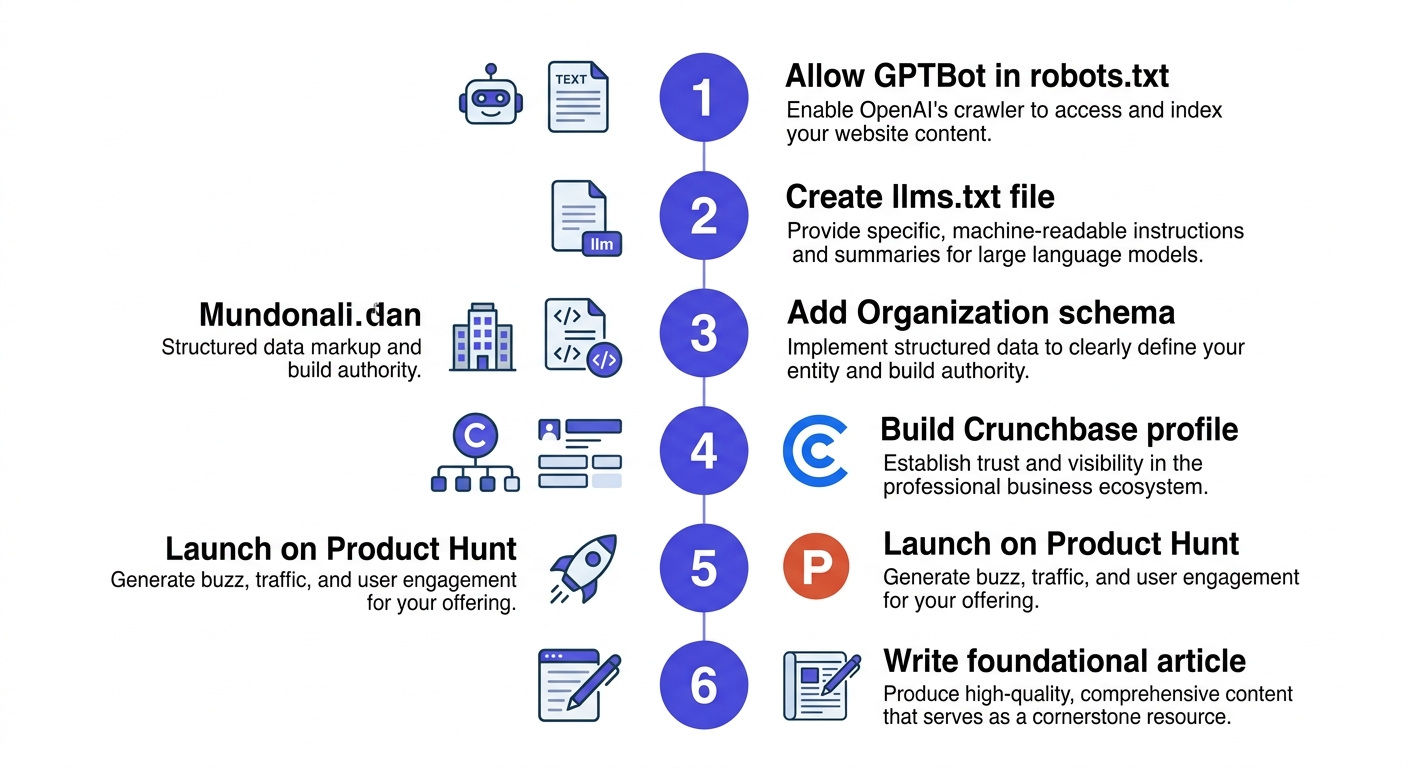
To rank in ChatGPT you need to (1) allow GPTBot in robots.txt, (2) get cited on high-authority sources in your category, and (3) create factual content that AI can quote. Most brands can see improvement within 4-8 weeks. This guide walks through all six steps with exact time estimates.
- ChatGPT has over 200 million weekly active users as of 2026 - the largest AI recommendation surface in the world
- A SaaS tool with 40 G2 reviews consistently outranks a tool with 50,000 users but no third-party citations in AI recommendations
- ChatGPT's browsing mode uses the same authority signals as Google for source selection
- Brands with 20-30 independent citations appear in ChatGPT category recommendations 80% of the time (GeoIQ audit data, 2026)
Getting your brand recommended by ChatGPT is one of the highest-leverage distribution moves available to founders in 2026. When someone asks ChatGPT for a recommendation in your category, they get one synthesized answer, not ten blue links. If your brand is in that answer, you reach a high-intent user who already trusts the recommendation. If you are not, you are invisible to that query.
This guide explains exactly how ChatGPT decides what to recommend, and gives you a precise six-step checklist you can work through in a single afternoon.
How ChatGPT actually works
ChatGPT answers from training data - a snapshot of the internet taken before its cutoff date. It cannot browse the web in real time unless the web search feature is explicitly enabled. This means your website content alone is not enough. You need to be cited by sources that were in ChatGPT's training data: publications, directories, review platforms, and community sites that OpenAI's crawlers indexed.
There are two modes to understand: standard ChatGPT draws entirely from training data, meaning citations from before the training cutoff are what matters. GPT-4o's browsing mode performs live web searches, applying authority signals similar to Google's - domain authority, inbound links, structured content, and freshness. Both modes need to be optimized for.
The practical implication: building citations on G2, Crunchbase, ProductHunt, and TechCrunch is not just good PR. Each of those platforms was heavily crawled by OpenAI during training. A brand with a complete G2 profile, a Crunchbase listing, and a ProductHunt launch is far more likely to appear in ChatGPT training data than a brand that only has a great website.
What signals ChatGPT trusts most
If 30 independent websites mention your brand in the context of your category, ChatGPT is far more likely to include you when that category comes up. Each independent mention is a vote confirming your brand belongs in the conversation. Frequency across diverse sources outperforms depth on any single site.
Being mentioned as a recommendation ('founders should try X') carries more weight than being listed in a directory. Reviews, case studies, and comparisons that position your brand favorably create stronger citation signals than plain listings.
If G2 calls you a 'CRM', TechCrunch calls you a 'sales tool', and your website calls you a 'revenue platform', ChatGPT sees three different things. The model cannot confidently recommend you because it does not know what category you belong in. Use one precise description everywhere.
More recent training data carries more weight, especially for fast-moving categories like AI tools. Coverage from 2024-2026 in relevant publications will be more impactful than older mentions from 2020, even from authoritative sources.
Step by step: how to appear in ChatGPT results
Work through these six steps in order. Steps 1-3 are technical fixes that take under an hour total. Steps 4-6 build the citation profile that moves your score over 4-8 weeks.
- Visit yourdomain.com/robots.txt in your browser.
- Look for: User-agent: GPTBot with Allow: / or no Disallow: / rule.
- If GPTBot is missing or blocked, add these lines to your robots.txt:
User-agent: GPTBot
Allow: /

User-agent: PerplexityBot
Allow: /

User-agent: Claude-Web
Allow: /
Also add anthropic-ai, OAI-SearchBot, and Google-Extended while you are there. Blocking any of these prevents that AI system from crawling your pages.
- Create a plain text file at yourdomain.com/llms.txt.
- This file tells AI systems about your brand directly - think of it as robots.txt for AI.
- Include: brand name, product description, target market, key use cases, founding year, team size, and links to key pages.
# [Your Brand] - llms.txt

## About
[Brand] is a [category] tool that helps [target user] [key benefit].
Founded [year]. [X] users in [Y] countries.

## Key pages
- Product: https://yourdomain.com
- About: https://yourdomain.com/about
- Blog: https://yourdomain.com/blog
Keep it factual and specific. AI systems parse this file to understand your brand context.
- Add this JSON-LD block to your homepage head tag.
- Organization schema tells AI systems your brand name, description, URL, and social profiles in machine-readable format.
- Gemini uses this directly to build knowledge graph entries for your brand.
<script type="application/ld+json">
{
  "@context": "https://schema.org",
  "@type": "Organization",
  "name": "Your Brand",
  "url": "https://yourdomain.com",
  "description": "One precise sentence about your product.",
  "foundingDate": "2024",
  "sameAs": [
    "https://linkedin.com/company/yourbrand",
    "https://twitter.com/yourbrand",
    "https://crunchbase.com/organization/yourbrand"
  ]
}
</script>
The sameAs field is especially important - it links your website to your profiles on platforms AI systems trust.
- Go to crunchbase.com/add-new/organization and submit your company.
- ChatGPT's training data includes Crunchbase heavily - it is one of the most-referenced startup data sources in AI training.
- Fill in every field: description, category, founding date, location, funding, team members.
A complete Crunchbase profile is worth more for ChatGPT visibility than 10 low-DA directory listings. Once submitted, it can take 2-4 weeks to appear in AI responses.
- Create a Product Hunt listing at producthunt.com/posts/new.
- Product Hunt is one of the most heavily indexed tech platforms in AI training data.
- Upvotes and comments on your listing amplify the signal - ask your network to engage on launch day.
A Product Hunt listing with 50+ upvotes is treated differently from one with 5. Launch on a Tuesday-Thursday for best engagement.
- Write a 1,500+ word factual article about your brand and category.
- Structure it with clear H2 headings answering real user questions, specific statistics, and your brand name mentioned naturally throughout.
- Publish it on your own domain first, then cross-post to Medium and dev.to.
This article becomes the canonical reference AI systems find when looking for content about your category. Write it like a Wikipedia entry - factual, structured, and comprehensive - not like a marketing page.
Frequently asked questions
Most brands see measurable improvement in 4-8 weeks after completing the six steps in this guide. Perplexity responds fastest - often within days of a new page being indexed. ChatGPT and Gemini depend on model update cycles and may take 8-12 weeks to fully reflect new citations.
Yes, indirectly. Pages that rank well on Google are more likely to appear in AI training data and in ChatGPT's real-time browsing results. But SEO alone is not enough: a brand can rank #1 on Google and still score 0/100 on GeoIQ if it has no third-party citations.
GPTBot is OpenAI's web crawler, used to train ChatGPT and retrieve pages for GPT-4o's browsing mode. You should allow it in robots.txt. Blocking GPTBot means ChatGPT cannot learn from your content or retrieve your pages in real-time browsing.
No. ChatGPT does not accept paid placements in conversational responses. Your brand appears in ChatGPT answers through training data coverage and citation frequency - both purely organic signals.
Your competitor has more independent citations across authoritative sources in ChatGPT's training data. They may be on G2, ProductHunt, Crunchbase, and covered in tech publications. Run a GeoIQ audit to see your score versus what a well-cited competitor looks like.
Yes, significantly. Wikipedia pages feed directly into AI training data and are weighted as high-authority sources. If you cannot get a Wikipedia page, Crunchbase and AngelList profiles are the next best alternatives.
TechCrunch, The Verge, Wired, Hacker News, ProductHunt, and Reddit's startup communities carry the highest weight. For India-specific visibility on Gemini: YourStory, Inc42, Economic Times Tech, and Entrackr are particularly valuable.
ChatGPT's browsing mode retrieves live web pages and cites them directly in responses. Your website content quality matters directly - structured headings, factual claims, and fast load times all help.
Use GeoIQ at geoiqai.com to run automated prompts across ChatGPT, Gemini, and Perplexity and track your visibility score over time. Free audit, no signup required.
Organization schema is the most important markup for ChatGPT training data - it provides machine-readable confirmation of your brand name, description, URL, and social profiles.
Brands with 20-30 independent citations on authoritative platforms consistently appear in category recommendations. There is no hard minimum, but fewer than 5-10 external mentions rarely appear reliably.
Submitting to ProductHunt takes 20 minutes and reaches a platform heavily indexed in ChatGPT's training data. Creating a complete Crunchbase profile takes 15 minutes. Both can begin moving your GEO score within 4-6 weeks.
At minimum, monthly. AI model updates change citation patterns and a brand visible last month may not be this month. GeoIQ's paid plans run daily monitoring with weekly digest emails.
Gemini uses Google's knowledge graph extensively - Google Business Profile, structured data markup, and coverage in Google-indexed publications matter more for Gemini than for ChatGPT.
Check your ChatGPT visibility score - free
See where your brand stands across ChatGPT, Gemini, Perplexity, Claude, and Grok. No signup. Results in 60 seconds.
Run free audit